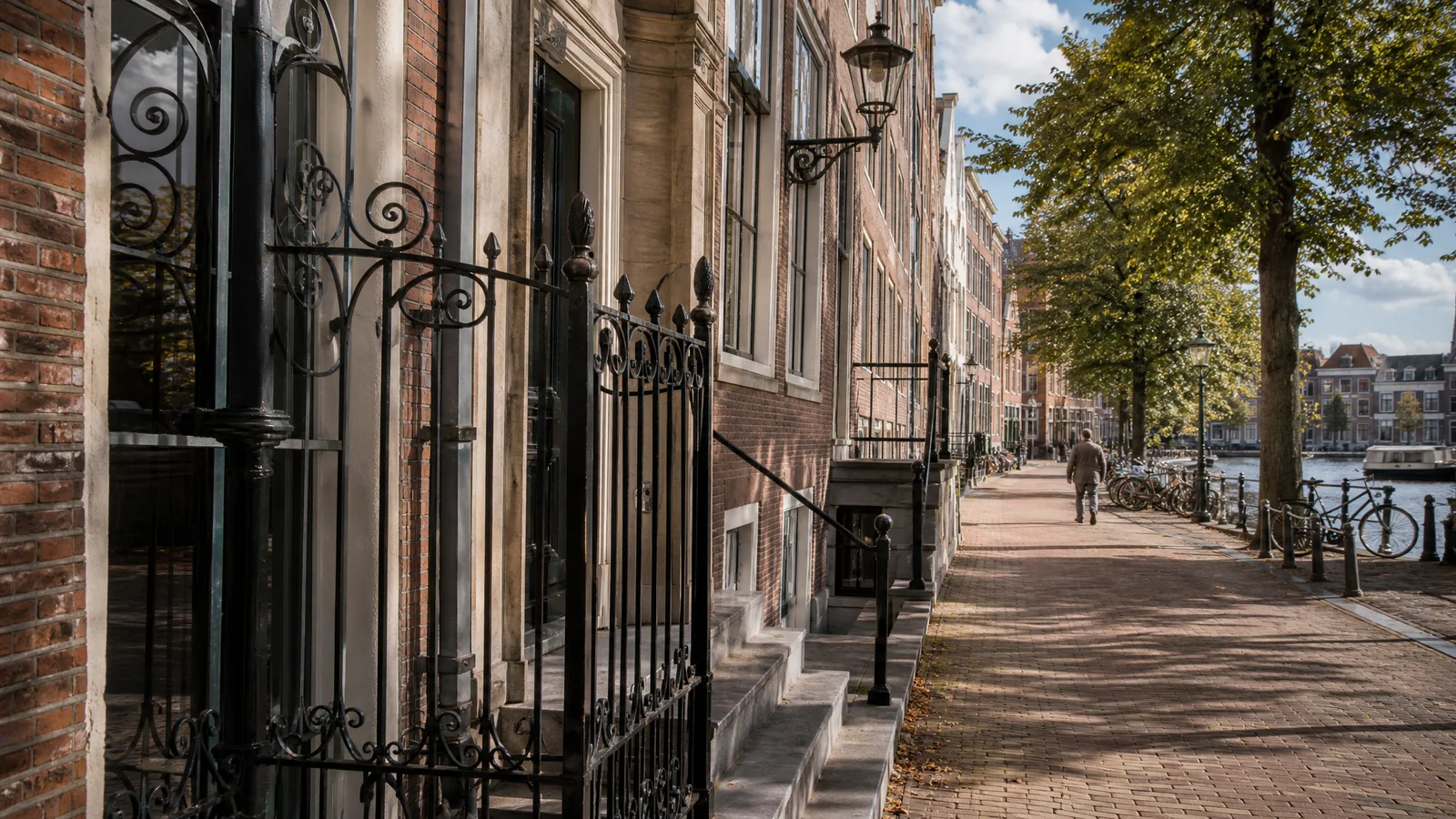
Start above eye level
Haarlem is a city where it is easy to look too low. On busy moments, pavements, bicycles, bags and shop windows take over. Just above eye level, the calmer half of the street begins: window rhythm, brickwork, older doorframes, gutter lines and small differences between neighbouring buildings.
You do not need a route for that. It works in short pieces: pause without blocking a doorway, look up, and move on. Gemeente Haarlem explains on its monument permit page that changes to monumental buildings usually require care and permission. That helps explain why many details are not simply decoration, but part of a protected city layer.
Reading the Gouden Straatjes slowly
Visit Haarlem describes the Gouden Straatjes as streets around the Grote Markt. Names such as Warmoesstraat, Anegang and Schagchelstraat are known for shops and craft, but for a slower reader they also matter because of scale: narrow plots, short facades, small height changes and corners where the light shifts.
Do not only look at what happens behind the glass. Notice the division of windows, the stone above an entrance, an old hanging point, an unexpected cornice or a facade that is just narrower than its neighbours. A commercial street becomes an ordinary Haarlem street again, where living, working, walking and looking overlap.
- Do not stop in front of doors, gates or narrow pavements.
- Look at the upper floor before leaving the street.
- Use quiet moments for photo or video, without identifiable people.
- Leave current practical details with the public source named in the article.
Why facades slow the city down
Monumenten.nl describes Haarlem as a major monument city where different historical layers remain visible. You do not only notice that at famous buildings. Ordinary streets show how medieval lines, later facades, shopfronts and daily use sit on top of each other.
A facade slows the city down because it asks nothing from you. There is no map to follow and no programme to catch. You simply see how a house, shop or former workspace meets the street, and how other people share the same limited space.
A small habit for locals and visitors
Do not turn facade watching into a performance. In Haarlem it works best when it stays small: look for two minutes, leave room for residents, do not film into windows and do not use entrances as a backdrop. The city remains readable without being pulled toward you.
For international visitors, this may be the simplest way to understand Haarlem. The centre is compact, but not flat. Looking up shows why short streets here still contain many layers.
Frequently asked questions
Where should you start reading Haarlem facades?
Start in calmer parts of the centre and look above eye level at windows, brickwork, doorframes and rooflines.
Is this a fixed walking route?
No. The article is a looking guide: short observations work better than a checklist route.
Why are heritage details sensitive?
Gemeente Haarlem explains that changes to monumental buildings usually require care and permission. Treat those details as part of the city, not as a backdrop.